Showing posts with label Kitchenalia. Show all posts

Tuesday, 2 February 2010

Life's A Beach

1950s Crown Devon Antigua Stucco dish from the series The Beach
Couldn't resist this Crown Devon dish from a series called The Beach, bought from an antique store in Esk (which, ironically is no where near a beach).

It's 30cm in length with a smooth red back and a stucco face with hand painted beach balls, bucket and spade, a deck chair and bathing machine popular during the time when beach belles didn't stroll nonchalantly half-naked to the water to take a dip.

Crown Devon started in 1870 and its life came to an end in 1982 with the last 60 years of its work more producing novelty and souvenir pieces. More history is here.

According to an eBay listing, a Crown Devon jug from the same collection, Antigua Stucco, dates to the 1950s, so it's reasonable to assume that this dish is about the same age.

Cute - but it's the closest I've been to the beach all summer!

Friday, 29 January 2010

Looking Smart In Tweed

Nifty Knick Knacks are back!

It has been a very long hiatus from sifting through all things nifty and from blogging in general - but that's life - it happens when you least expect it.

While the updates have dried up, the collecting hasn't. While Nifty Knick Knack postings will be a little less frequent than before, there will be at least two updates a week.

One thing which has been lovely is discovering that we have no where near exhausted the supply of Gold Coast souvenirs. There's at least another four in the collection and they'll be profiled over the next few weeks.

This one is the most recent in our collection thanks to a last minute eBay bid.
Looking East down Wharf Street Tweed HeadsIt's a candy dish with what seems to be a 1930s view looking north-east along Wharf Street across the New South Wales border town of Tweed Heads to its adjoining 'twin', Coolangatta in Queensland.

From the Gold Coast City Council's local studies library is the photograph on which this transfer print is based.
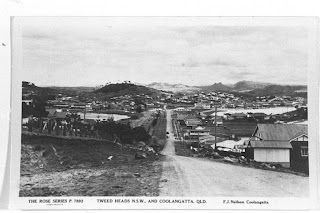
Here's the photograph of the same view

Of course, none of the buildings found in this picture exist any more but that's just par for the course on the Coast.

Here is a Google map reference for that street.

There used to be a Myer store on that street, just on the New South Wales side of the border but that closed down in the late 1970s when Tweed Mall, now Centro Tweed was opened.

That Myer was the only one for 120km and in the days before Pacific Fair Brisbane or Tweed were your only choices for upmarket furniture and household items not quite as upmarket or as old money as David Jones mind, but very flash for a working class family all the same.

My mother bought this in the mid 1970s from that very Myer. Here's some info on it from one of our links, Retro Select.
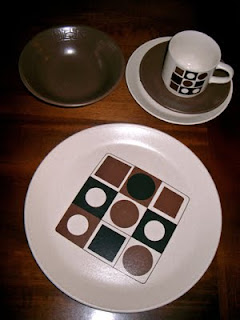
1970s Johnson Brothers Stoneware dinner set

I don't recall the occasion, except as a child a trip aaalllll the way into NSW was a day-long adventure.

I do remember is being fascinated by fabulous coin operated carousel dappled horse that sat outside the store.

According to the pillar box red coin box was sixpence a ride, even though pounds, shilling and pence had gone a decade earlier.

What a bargain I thought, it used to be sixpence now it's five cents!

Saturday, 24 May 2008

What A Dish!

Nicky is such a romantic.

He knew the perfect thing to buy me for our wedding anniversary - this 1950s Crown Devon Dish.

It's part of the Gaiety Grill collection, a whimsical series of serving dishes and platters illustrated with fruits, vegetables and sausages entertaining around the grill.

According to Retro Select, the pieces are relatively rare. But their rarity value means less to Nick and Nora than having a fun talking point around the family barbecue.

If you're interested in the interior and homeware design of the period, just a wuick peek at some of Sir Terence Conran's charming and iconic pieces.

Friday, 14 September 2007

Spacy

The space race brought us more than just man walking to the moon and communications satellites.

Not everyone was going to be a John Glenn or a Buzz Aldren, but everyone could have a little of the final frontier all of their own.

Ignoring World War Two, industrial and commercial designers picked up more or less right from the Art Deco period to develop a style which influenced buildings, cars and interior furniture - known as Raygun Gothic.

This Carlton Ware plate is an example of the genre. Called 'Orbit' it ignores the conventions of crockery.

It's rectangular, has abstract patterns and a vivid splash of red on one side.

As a single piece it has a certain a retro novelty but in the Carlton Ware style nothing exceeds like excess and during the late 1950s and 1960s Orbit platters (warning, gratuitous pun alert) spun off into cruet sets and coffee sets.

BTW, Nora loves the Seattle Space Needle, a building she knew long before she saw a photograph of it - as did every re-run cartoon watching child of the 1960s and 1970s.

It's where The Jetsons lived!

Tuesday, 4 September 2007

Bargain Hunt

Nick and Nora took a little time for themselves and enjoyed four days camping in the great outdoors of south-east Queensland.

The return trip necessitiated a stop at the Toogoolawah Red Cross op shop to say hello to the lovely hard-working volunteers and for a bit of bargain hunting.

For the princely sum of $11.50 Nick and Nora acquired:

A late 1950s Midwinter Brand platter ($5)


A 1950 book on Queensland (50c)


A 1953 Queen Elizabeth II coronation souvenir book ($4)


A 1960 children's atlas ($1)


A 1960s blue Tupperware jug with hinged lid ($1)


The Queensland and coronation books are a real treat and they'll make features of their own in coming weeks.

If you're in this part of the world, Nick and Nora also recommend the Beaudesert Swap Meet (this year on September 16).

Tuesday, 3 July 2007

All Shook Up


The wonderful thing about vintage pieces is the level of attention paid to its design.

Little touches done not because they had to but because they could. Like this 1960s vintage Tupperware colander, a piece of kitchenalia which is in daily use in the Charles household.

Picked up for 50 cents at the local Op Shop, this piece appeals not just because of its frugal price tag.

Yes, a very useful household item, but take a look at the decorative pattern the holes marked in the base - a geometric snowflake.


Another thing remarkable about this piece is the stamp - made in Australia.

Unfortunately Nick and Nora have not been able to find out much about Tupperware's manufacture in Australia but Nora seems to recall that in the mid-1990s a dealer telling her that Tupperware stopped local production about 10 years earlier.

She'd love to hear from anyone who can shed light on Tupperware's history in Australia. Nora has found out that an entrepreneurial man by the name of Chris Paton - is not only credited with bringing Tupperware to Australia but is also considered to be the father of the Australian macadamia nut industry - true story.

But if the functionality and the plain aesthetic value of this vintage Tupperware is not appealing enough, take a look what an artist has re-engineered for this perfect piece of petrochemical.

The artist is Tony Meredith a talented furniture and product designer. Do take a look at his web site and his work. It's delightful.

Thursday, 14 June 2007

Somewhere Over The Rainbow


This post is for Ann, who recalled the anodysed tumblers that her mum made the family use "when we wanted our Kool-Aid al fresco".

Anodizing, or anodising, is an electrolytic passivation process used to increase the thickness and density of the natural oxide layer on the surface of metal parts.

Well, so says Wikipedia.

But that doesn't go anywhere near explaining the romance and nostalgia that comes from owning andoysed aluminium kitchenalia. For those of us who grew up in the 1960s and 1970s, this was the epitome of chic, style and practicality.

Perhaps someone will feel the same way about 1980s acrylic glasses, but somehow, we don't think so.

Coming in a rainbow of colours, these mugs are the very promise of spring and summer picnics and everyone had 'their' favourite. For Nora's it's lavender.

This set spend the bulk of its life in the glovebox of Nora's grandad's car, just in the right place for an impromptu Sunday drive down to the Northern New South Wales beach town of Hastings Point.

Tuesday, 12 June 2007

Fresh Sealed


Nothing epitomises the marvel of the modern age than Tupperware.

The fantastic plastic, first came on the market in 1946 and from the 1960s spread throughout the globe.

Nora confesses to a certain fascination for Tupperware - is it the practical nature of the product? The retro styling from her op-shop finds? She's not yet decided so Nick has asked her to limit purchases to items that have either practical application in the Charles household or which demonstrate a specific style aesthetic.

That Tupperware's styling reveals much about post-War domestic design is part of the charm of collecting.

Pictured is an excellent condition sugar and creamer in a design called Harvest Gold produced in (we think) the 1970s.

Check out the soft, compact curves in the single moulded body of the creamer and sugar container and the deconstructed floral element.

Come back this time next week to see another piece from the Tupper-Tuesday collection.